
TMJ / TMD Treatment
Beverly Hills

TMJ and TMD treatment in Beverly Hills by Dr. Joseph Goodman. 27 years of conservative care. Custom night guards and gentle bite work to ease jaw pain, clicking, and headaches. No surgery first.

porcelain veneers by Dr. Goodman featured on CBS
porcelain veneers by Dr. Goodman featured on TheDoctors TV
porcelain veneers by Dr. Goodman featured on Miss California
porcelain veneers by Dr. Goodman featured on Cosmopolitian
porcelain veneers by Dr. Goodman featured on Dr. Phil
porcelain veneers by Dr. Goodman featured on beverly hills chamber of commerce

Relief for Jaw Pain, Clicking, and Headaches

TMJ treatment in Beverly Hills helps you find relief from jaw pain and tension headaches. Dr. Joseph Goodman has practiced cosmetic and general dentistry for 27 years. He has cared for three generations of families in the same Beverly Hills office. The temporomandibular joint, or TMJ, is the hinge that connects your jaw to your skull. When that joint or its muscles strain, the result is a disorder called TMD. Dr. Goodman finds the cause and eases the pain with conservative care first.

Here is what that means for you. Dr. Goodman starts with the least invasive care, not surgery. He often begins with a custom night guard and simple bite balancing. When a worn bite is the problem, custom crowns can restore it. Missing teeth that throw off your bite may call for dental implants. He uses his FACE Dentistry approach to find what is straining the joint. Below you will learn the signs, the treatments, the comfort, and the cost.
What Is a TMJ Disorder?

A TMJ disorder, or TMD, is a problem with your jaw joint and the muscles around it. You have two of these joints, one in front of each ear, where your lower jaw meets your skull. They work with your teeth and muscles every time you chew, swallow, yawn, speak, or smile. Strain them and you feel pain, clicking, or trouble opening wide. Cleveland Clinic notes that TMJ disorders often bring jaw pain, headaches, and trouble chewing. The condition is common, and it usually starts between ages 20 and 40. Stress, grinding, injury, or a bad bite can set it off. Most cases improve with simple care.

When your bite is balanced, your teeth, muscles, and joints work together smoothly. When it is uneven, the jaw has to compensate, and that extra load strains the muscles and joints over time. This is the difference between the TMJ and TMD, one is the joint, the other is the disorder of that joint. Your jaw works hard all day, so when the bite, muscles, and disc fall out of balance, pain follows. Dr. Goodman looks at the joint, the muscles, and your bite together. This full picture points him to the real cause, not the symptom alone.

CLICK to GET DIRECTIONS

Phone:

Call: (310) 860-9311
Click to Text Us

Address:

241 1/2 S Beverly Dr Suite 201,
Beverly Hills, CA 90212

Dr. Joseph Goodman, DDS, DMD
California License 47521

Office Hours

Monday – 9:00am – 7:30pm
Tuesday – 8:00am – 5:00pm
Wednesday – 8:00am – 5:00pm
Thursday – 8:00am – 5:30pm
Friday – 8:00am – 4:00pm
Saturday & Sunday – Closed

See Inside Our Practice

What Causes a TMJ Disorder?

Most TMJ disorders come from strain on the joint or the muscles around it. Grinding and clenching top the list. They load the joint for hours while you sleep. A bad bite forces your jaw to work harder to make your teeth meet. Stress tightens the jaw muscles. Injury to the face or jaw can damage the joint. Arthritis wears it down over time.

Here is why that strain turns into pain. Deep inside the joint, behind the rounded end of your lower jaw, sits a small cushion of tissue (the retrodiscal tissue) full of blood vessels and nerve endings. When your jaw keeps closing into the wrong position, it presses on that tissue. Over millions of chewing and swallowing cycles, the pressure can irritate and inflame it. That inflammation is what many patients feel as jaw pain, fullness in front of the ear, or a dull headache.

Dr. Goodman looks for the cause in your case, not a generic label. He checks your bite, your muscles, and your grinding history. He asks about stress and past injuries. This full picture tells him where the strain starts. He treats the cause he finds, so your relief holds.

How Do TMJ Treatment Options Compare?

TMJ treatment runs from simple home steps to surgery in rare cases. Most patients start with a night guard and bite care. If pain lingers, medication, injections, or physical therapy can help. Mayo Clinic notes that surgery is reserved for severe, stubborn cases. The right step depends on the cause and how long you have had it. The table below lines up the main paths. Dr. Goodman always starts with the least invasive option that fits.

Option How it works Trade-off
Night guard and bite care A custom guard rests the joint and balances the bite Gentle and reversible, needs nightly wear
Bite correction and FACE Dentistry Repositioning the jaw, adjustments, crowns, or aligners fix the bite that strains the joint Fixes the root cause, takes more time and cost
Medication and therapy Anti-inflammatories, injections, or jaw exercises ease pain Helps symptoms, may not fix the cause
Surgery A procedure repairs or resets the joint Invasive, saved for severe cases only

Each path fits a different cause and severity. A night guard is the easy, low-risk place to start. Medication and therapy add relief when muscles stay tight. Surgery helps the few cases that conservative care cannot. Most patients never need anything beyond the gentle steps. Dr. Goodman walks you through the trade-offs before you choose.

Signs of a TMJ Disorder

What Are the Signs of a TMJ Disorder?

A TMJ disorder shows up in and around your jaw and the most common sign is jaw pain or tenderness near the joint. 1 of 4 of our patients also hear clicking, popping, or grinding when they open wide. Jaw pain, aching around the ear, and trouble chewing are classic signs. Some patients feel the jaw lock or catch for a moment. Headaches, earaches, and ringing in the ears can come along too. The list below shows what to watch for.

  • Jaw pain or tenderness, often worse with chewing
  • Clicking, popping, or grinding when you open or close
  • A jaw that locks or feels stuck for a moment
  • Headaches in the temples, forehead, or back of the head
  • Ear pain, fullness, or ringing with no ear infection
  • Aching in the face, neck, or shoulders

You may have every symptom or only one, and the pain often comes and goes. It flares during stressful weeks, then quiets down. Many people live this way for years before they get help. Wait too long and the strain builds while the pain spreads. Dr. Goodman traces each symptom back to its source, the joint, the muscles, or the bite. Act early and the fix is usually simpler.

How Does a Dentist Treat a TMJ Disorder?

A dentist treats most TMJ disorders without surgery. Dr. Goodman often starts with a custom night guard that protects your teeth and rests the joint. He may balance your bite so the teeth meet evenly and the muscles relax. TMJ care can also include trigger point injections, medication, or physical therapy. His FACE Dentistry approach checks how your upper and lower teeth meet. An uneven bite forces the jaw to strain and can fuel headaches. Dr. Goodman targets that root cause, not just the pain.

2 out of 4 of our patients feel real relief from the night guard alone. When the bite is the problem, Dr. Goodman may reshape or rebuild it. Worn or missing teeth that unbalance the bite can be restored. For crowded teeth, clear aligners can move them into a healthier bite. He saves surgery for the rare cases that need it. Most people get better with the gentle steps first.

Porcelain veneer consultation in beverly hills

How Much Does TMJ Treatment Cost?

You want to know what TMJ treatment costs before you commit, and the honest answer is it depends on what your jaw needs. Most people start with a custom night guard, which is the most affordable option and often the only one required. If your bite needs real correction, crowns, aligners, or bite balancing, the cost goes up because the work goes deeper. Complex cases that need imaging, injections, or surgery cost more still. Your dental insurance may pick up part of it, so it helps to check your benefits first. Dr. Goodman walks you through a clear quote before any work begins, so nothing surprises you.

You will never get pushed into work you do not need here. Dr. Goodman starts with the simplest, lowest-cost step that helps. He explains what each option costs and what it includes. The practice accepts CareCredit and financing for larger plans. He only moves to bigger treatment when the simple steps fall short. You decide with the full number in front of you.

CHOOSE YOUR

DENTIST WISELY

BEGIN YOUR PERSONALIZED DENTAL EXPERIENCE WITH DR. GOODMAN

You deserve a dentist who listens before recommending anything, tells you honestly what you need and what you do not, and delivers results that look like the best version of you. Dr. Joseph Goodman DDS DMD, California License 47521, has been delivering natural-looking smile transformations in Beverly Hills since 1999, serving patients from West Hollywood, Century City, Brentwood, and as far as the UAE and Germany. Call (310) 860-9311 or schedule your consultation today.

Contact Us

Frequently Asked Questions

Can a TMJ disorder cause headaches or migraines?

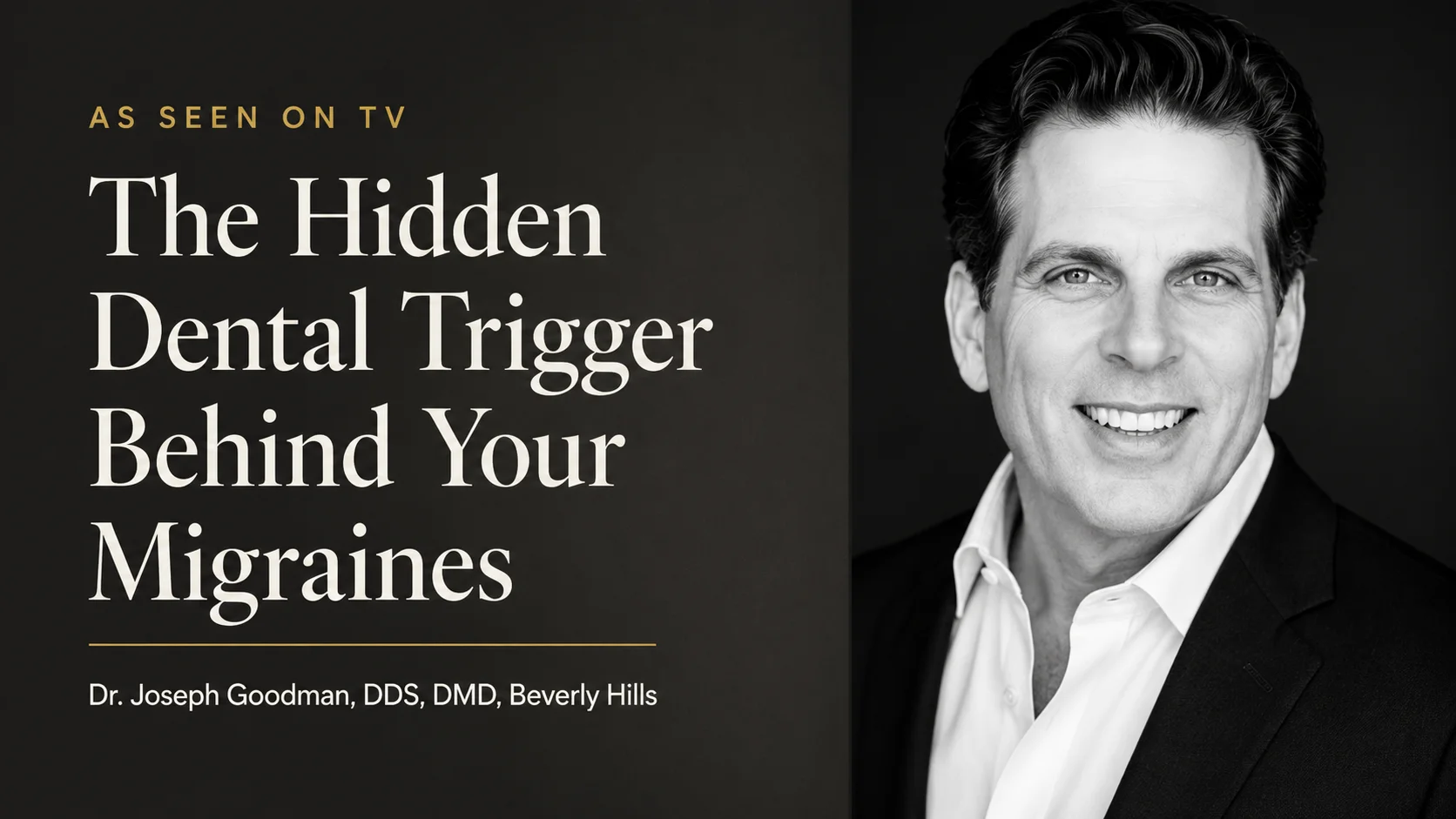
Yes, jaw strain is a common and overlooked source of head pain. Tight jaw and temple muscles can trigger tension headaches and even migraines. Bruxism and TMJ trouble are linked to headaches and migraines in many patients. Teeth grinding often brings on dull headaches around the temples. Dr. Goodman’s FACE Dentistry approach checks whether your bite is feeding the pain. When the bite is off, the jaw overworks and sends pain to your head. Easing that strain often quiets the headaches.

Can crowns or implants fix a TMJ problem from a bad bite?

Sometimes, when worn or missing teeth throw your bite off balance. Crowns can rebuild worn-down teeth so the bite meets evenly again. An even bite spreads the force and takes strain off the joint. When teeth are missing, dental implants restore the bite and the support. A balanced bite lets the jaw muscles relax and the pain settle. Dr. Goodman only suggests this when the bite is the real cause. He starts with simpler steps before any restorative work.

Can I get sedation if I am nervous about TMJ treatment?

Yes, comfort options are always on the table. Most TMJ care is gentle, so many patients need nothing extra. For nerves, sedation can keep you calm and relaxed through any visit. Dr. Goodman also uses local anesthesia for anything that might sting. An in-house anesthesiologist handles deeper sedation when you want it. He talks you through each step before he starts. You stay in control of how much support you want, every step of the way.

Why do I grind my teeth, and what helps right away?

Grinding often comes from stress, but it can also tie to your sleep. Sleep apnea and teeth grinding frequently show up together at night. Treating a sleep problem can sometimes ease the grinding too. For a painful flare, short-term medication like an anti-inflammatory can help. A custom night guard then protects your teeth while you sleep. Dr. Goodman looks for the cause, not just the symptom. He may suggest a sleep check if the signs point that way.

Does TMJ Treatment Hurt?

Most TMJ treatment is comfortable and far gentler than people fear. A custom night guard is painless to wear and simple to get used to. Bite balancing involves light reshaping, with no needles and no drilling into nerves. The recommended approach is less is often best, starting with the simplest care. Sixty percent of Dr. Goodman’s patients deal with dental anxiety, so comfort comes first. He explains each step before he begins. Nothing happens until you feel ready.

The information on this page is provided to help you understand TMJ treatment and the cosmetic services Dr. Goodman provides. It is not a substitute for professional diagnosis or individualized treatment. (For personalized guidance, please schedule an appointment with our licensed dental professional.)

Choose Your Dentist Wisely