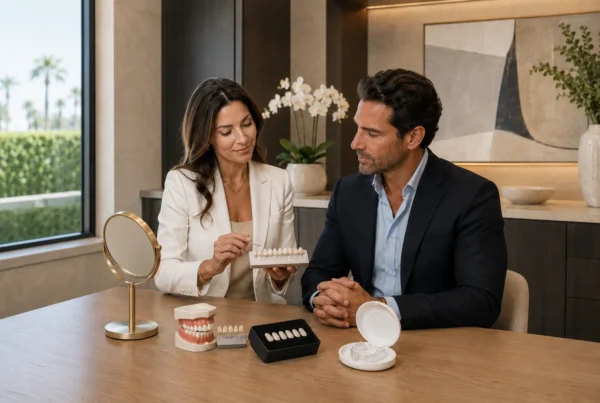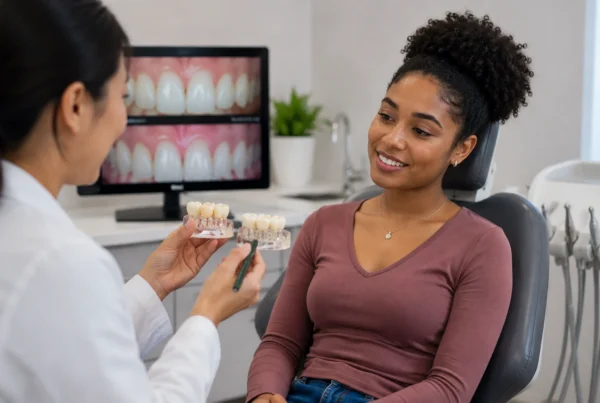

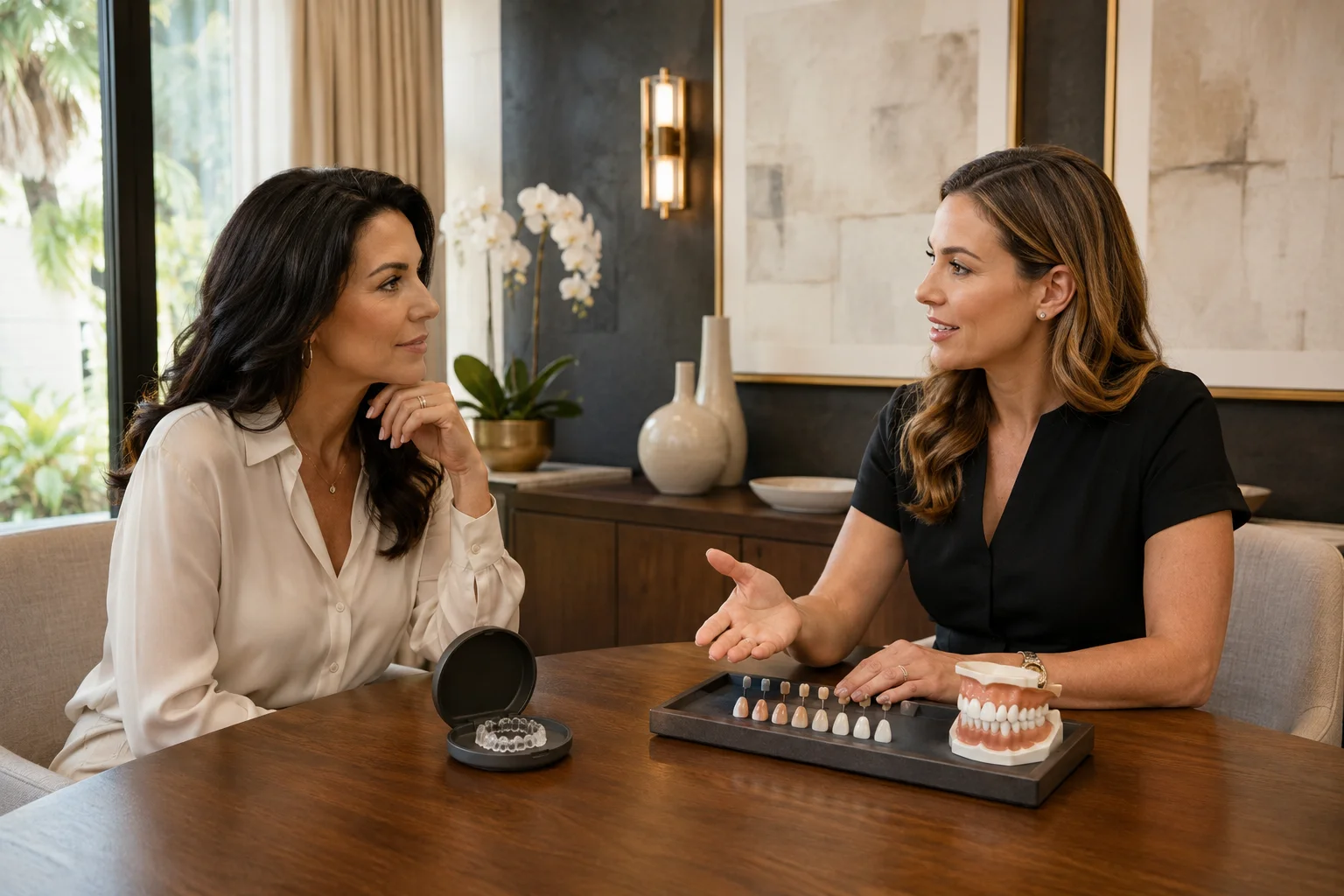

Clip-on veneers and porcelain veneers get compared as if they were two versions of one thing. They aren’t. Dr. Joseph Goodman, DDS, DMD, has placed cosmetic restorations in Beverly Hills for 27 years. He holds California license 47521, and he trained in both Germany and the United States. One of these is a removable appliance you order online, and the other is dentistry.
The appeal of the clip-on is obvious. No drilling, no commitment, and a price that reads as a rounding error beside porcelain. What buyers don’t hear is what happens to the teeth underneath while the shell is sitting on them. Nor how the thing behaves in daylight and in conversation. Order the wrong one and you have spent real money on what amounts to a photo prop. Worse, you can hide a problem that keeps growing while it’s covered.
Do Clip-On Veneers Do What They Promise?
They cover, and they do not correct. A clip-on is one molded shell, a single piece spanning six to ten front teeth at once. Most get made from an impression you take yourself at home, unchecked. It hides stains, small gaps, and mild crowding the moment you put it in. It changes nothing underneath.
Research on how users experience them is thin, which is worth knowing on its own. One 2024 pilot study surveyed users of direct-to-consumer snap-on veneers. Most of them reported discomfort, and most said they would not recommend the appliance to anyone else. That is a small study, not a settled verdict. It is also close to the only data anyone has on the question.
The shell is also molded as one uniform piece of resin. Real teeth vary in translucency all the way from the gumline out to the biting edge. That gradient is what stops porcelain veneers from reading as plastic. A single opaque shade catches the eye in the way patients most want to avoid.
Can You Eat With Clip-On Veneers?
Not comfortably, and most makers tell you not to try. Most sets are built for a few hours of wear rather than three meals a day. The appliance sits over your biting surfaces. It changes how your teeth meet, and how food breaks down when you chew. Hard and sticky foods are out of the question entirely. Most wearers take them out to eat and put them back afterward.
That single limitation defines what a clip-on is really for, and what it is not. It works for a wedding, a shoot, or an evening when you want to look a certain way briefly. As daily wear it turns into a maintenance problem instead. Anything trapped between the shell and the tooth stays there. Bacteria underneath the shell do not take the night off.
What Do Clip-On Veneers Hide Instead of Fix?
This is the part where the cheap option quietly turns into the expensive one. A shell over a tooth conceals only the visible signs of the problem. It carries on underneath, unseen and untreated. Nothing about the cover slows any of it down.
- Decay, which keeps advancing behind a cosmetic cover
- Gum disease, where bleeding and recession get masked rather than treated
- A bite that is wearing your teeth down unevenly
- Cracked or failing old restorations
- Alignment problems that need orthodontics, not a cover
None of that shows up in a photograph. It shows up two years later as a considerably bigger bill. Between 25 and 30 percent of new cosmetic patients here arrive unhappy with work done somewhere else. Delayed treatment is a recurring theme running through those cases. Results vary, and an exam is the thing that tells you which category you fall into.
Which One Fits Your Situation?
The honest sorting rule fits in two lines. If the goal is one evening, a clip-on will do the job. If the goal is your face for the next decade, it does not.
| Clip-on veneers | Porcelain veneers | |
| What it is | Removable appliance | Bonded restoration |
| Enamel removed | None | Yes, permanent |
| Eating | Usually removed first | Normal function |
| Typical lifespan | Months to a few years | 10 to 20 years |
| Fixes the underlying problem | No | Where the problem is cosmetic |
| Dentist involved | Often none | Required |
Between those two sits an option that most people skip over entirely. Dental bonding is real dentistry. It costs a fraction of a full porcelain case and stays reversible. No-prep veneers sit closer to porcelain while removing far less enamel. Ask about both before deciding the choice is only an online kit or a full case.
What Does Real Porcelain Buy You?
Porcelain gets bonded onto a tooth the dentist has prepared. It becomes part of the tooth rather than a thing resting on top of it. Enamel gets removed to seat it, which is what makes the decision permanent. You are paying for a restoration that behaves the way a tooth does.
- Layered translucency that matches how light moves through enamel
- A margin at the gumline you can clean like a natural tooth
- Full chewing function, with no removal before meals
- Stain resistance that holds the shade for years
- A shape and length designed around your face, not a stock mold
Well-placed veneers here run 15 years and longer, and the smile gallery shows how they read in daylight. Patients from Hancock Park and Cheviot Hills often open this conversation holding a clip-on they already bought online. That is a useful starting point. It tells Dr. Goodman what they want their smile to look like, and what they have learned they don’t want.
Find Out Which One Your Teeth Need
An exam tells you what a photograph cannot, and it costs you nothing but an hour. Dr. Joseph Goodman, DDS, DMD, has spent 27 years on cosmetic cases at his Beverly Hills dental practice. Patients arrive from Rodeo Drive and the streets around Beverly Gardens Park. His training in Germany and the United States built a practice around one rule. Diagnose first. Then choose the smallest thing that fixes what you found.
Bring the clip-on with you if you already bought one. It shows what you’re after far better than any description of it would. Call (310) 860-9311 or start on the cosmetic dentistry page. Results vary by case. You’ll get a straight answer on whether porcelain is the right call at all.
Questions Buyers Ask First
Do dentists recommend snap-on veneers?
Most treat them as a costume rather than treatment, and the available research supports that read. A 2024 pilot study surveyed users of direct-to-consumer snap-on veneers. Most experienced discomfort and would not recommend them to others. The authors also flagged how little research exists on the safety and long-term effects of these products. That gap is the point. A dentist can tell you what a given product does to your gums across months of wear. Nobody has that data here.
What is the cheapest way to get veneers?
The cheapest route in the moment turns out to be almost never the cheapest over time. The American Dental Association issued a public warning in May 2024 about unlicensed “veneer technicians” offering discounted work. It cited risks including infection from adhesives and curing devices that were never sterilized. The ADA also flags nerve damage from improper filing and veneers placed over untreated cavities. Redoing a failed case costs considerably more than having it done properly the first time. If price is the real constraint, ask about bonding. Do not ask for a discount on porcelain.
How do your teeth not rot under veneers?
They can, which is exactly why the tooth has to be healthy before anything goes over it. The ADA is direct that you can still get cavities under or around a veneer. Brushing and cleaning between your teeth still matter. A bonded porcelain veneer has a sealed margin at the gumline that a dentist checks at every visit. A removable clip-on has no seal against the tooth at all. That difference is why one counts as monitored care and the other is only a cover.
How long can you wear clip-on veneers?
Makers generally position them for hours rather than all day, and hygiene is the whole reason why. Plaque left on a tooth hardens into tartar, as MedlinePlus explains. Brushing cannot remove it once that happens. An appliance sitting over your teeth traps exactly the film that produces that tartar. If you wear one, clean both the appliance and your teeth every single time it comes out. Persistent gum soreness or an odor means stop wearing it and get looked at properly.
Related Services
Related Articles