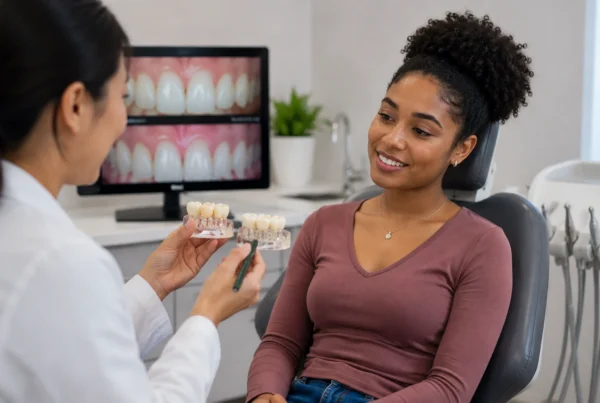



Porcelain veneers, dental bonding, and teeth whitening fix three different problems. Mixing them up gets expensive. Dr. Joseph Goodman, DDS, DMD, has practiced cosmetic dentistry in Beverly Hills for 27 years. He holds California license 47521 and trained in Germany and the United States. The right choice comes down to what’s wrong with your teeth, not what you saw online.
Most people arrive already convinced they need veneers. The worry underneath is looking fake, or paying for permanent work you didn’t need. Getting this wrong means enamel you can’t put back. It also means a smile that reads artificial in photographs, which is the opposite of the point. So the sorting question matters more than the sales pitch.
Which Option Fits the Problem You Have?
About 20 percent of patients who ask Dr. Goodman for veneers leave with a plan for bonding or whitening instead. That’s a first-party figure from this practice, not an industry average. The sorting rule itself is simple. Color problems go to whitening, small shape problems go to bonding, and structural problems go to porcelain veneers.
Where it gets confusing is that all three can improve a tooth in a photograph. They don’t hold up the same way over years, though. They don’t cost the same either. A patient chasing a whiter smile ends up with 20 porcelain units. That is a lifetime commitment bought to solve a color problem. Have that conversation in the first appointment.
Starting small also keeps your options open for later. Whitening changes nothing permanently, bonding can be removed, and porcelain cannot. Each step forward closes the one behind it. That is the reason Dr. Goodman works from the least invasive end of the list first.
What Can Dental Bonding Fix?
Dental bonding handles small, contained problems, and it usually requires no enamel removal at all. Your dentist applies a tooth-colored composite resin, shapes it by hand, and cures it with a light. One visit. Because nothing gets removed from the tooth underneath, the work stays reversible later.
That reversibility is the entire argument for starting here rather than reaching for porcelain. A chipped corner, a narrow gap, an edge that wore unevenly. Each responds well to dental bonding. Patients from Bel Air and Holmby Hills often come in expecting a full case and leave with one bonded tooth. Bonding buys you time too, since you can move to porcelain years later without having spent any enamel.
When Is Teeth Whitening Enough on Its Own?
Whitening works on the outer layer of enamel, so it only helps when the color sits on the surface. The ADA’s consumer guidance sorts the outcome into three bands. Yellow teeth generally bleach well, brown teeth respond less predictably, and gray tones may not lighten at all. There is a second limit people discover too late.
- Crowns, which keep whatever shade they were made in
- Porcelain veneers, no matter what the surrounding teeth do
- Existing bonding and tooth-colored fillings
- Intrinsic discoloration from medication or an injured nerve
Whiten around old restorations on your front teeth and they stand out more. That is why professional teeth whitening gets sequenced first. Any restorations then get matched to the shade your natural teeth settled at.
When Do You Genuinely Need Porcelain Veneers?
Veneers earn their place when shape, position, and color all need changing at once. Dr. Goodman’s average case runs 20 veneers, 10 upper and 10 lower. A partial case rarely reads as one smile in a photograph, because the eye catches the transition. Five findings point toward porcelain rather than something smaller.
- Teeth worn down enough that length, not only color, has changed
- Intrinsic discoloration that bleaching cannot reach
- Several teeth with shape or position problems, rather than one or two
- Existing veneers that look thick, opaque, or a poor fit
- A bite that needs restoring at the same time as the smile
Between 25 and 30 percent of new cosmetic patients here arrive unhappy with work done somewhere else. The pattern behind that unhappiness stays consistent across those cases. Veneers too thick, too opaque, poorly fitted, or wrong on color and shape. Correcting a bad case costs more than doing it right once, and it takes longer. Results vary, and a proper exam is what separates these groups.
How Long Does Each One Last?
Longevity is where the three options separate most clearly for anyone weighing the cost. Bonding needs touchups every three to 10 years. Porcelain veneers need replacing every 10 to 20. Whitening isn’t a restoration at all, so it fades on a maintenance schedule rather than a replacement one.
| Teeth whitening | Dental bonding | Porcelain veneers | |
| Enamel removed | None | Little to none | Yes, permanent |
| Reversible | Yes | Yes | No |
| Typical lifespan | Maintenance based | 3 to 10 years | 10 to 20 years |
| Best for | Surface staining | Chips, gaps, edges | Shape, color, and position together |
| Stain resistance | Not applicable | Lower than porcelain | High |
Well-placed veneers here run 15 years and longer, and the before and after gallery shows what that looks like. That sits at the top of the published range rather than the middle of it. The gap comes down to lab work, the fit at the gumline, and whether the bite was corrected first. Ask any dentist what their own cases look like at year 15. A published range tells you nothing about their hands.
Get a Straight Answer Before You Commit to Porcelain
The exam is what settles this, and it costs you nothing to have one. Dr. Joseph Goodman, DDS, DMD, has been a trusted dentist in Beverly Hills for 27 years. Patients reach him from North Canon Drive and the streets around the Golden Triangle. His training in Germany and the United States built a practice with a rule. Start with the least invasive option that will hold. What patients want is to stop thinking about their teeth in photographs. That is a different goal from wanting the most treatment.
Bring your questions and any cosmetic work you’ve had done elsewhere. You’ll leave knowing which of the three fits your teeth, and why the other two don’t. Call (310) 860-9311 or start on the cosmetic dentistry page. Results vary by case, and you’ll get an honest answer either way.
Questions Patients Ask Before Choosing
Why do dentists advise against veneers?
Some dentists steer patients away because veneer treatment can’t be undone once it starts. Enamel is removed to seat the porcelain, and it doesn’t grow back. The American Dental Association states that plainly in its patient guidance. The ADA flags two groups worth noting as well. If you clench or grind, veneers may not be a good choice yet. The same goes for a deep overbite. Any decay or gum disease has to be treated first, since porcelain over unhealthy teeth makes the underlying problem worse.
What are the downsides of dental bonding?
Composite resin is more porous than porcelain, so it picks up stain from coffee, tea, and red wine. It also chips. It doesn’t last as long as porcelain either, as Cleveland Clinic notes. Whitening products won’t lighten it either, so a bonded front tooth keeps the shade it was made in. For small corrections that trade is usually worth making. Across a full smile, the maintenance adds up faster than most patients expect.
Do teeth turn yellow again after whitening?
Some rebound is normal. Your teeth still stay lighter than they started, and the research on this is unusually specific. A two-year randomized trial followed 92 patients through at-home bleaching, recalling 88 percent of them at the end. Shade stayed significantly lighter than baseline, but more than 66 percent of participants in each group reported some shade relapse. Coffee, tea, red wine, and tobacco drive most of that drift over time. Touchups every year or two hold the result rather than restarting it.
Can black tooth stains be removed?
It depends entirely on what’s causing the black. Surface staining from food, drink, or hardened tartar comes off with a professional cleaning. Diet-related discoloration on the outer layer often responds to whitening, as MedlinePlus explains. Black that comes from decay, or from a tooth that lost its nerve, is a different matter. That needs treating as a health problem first, well before anyone discusses appearance. A dental exam with X-rays tells you which one you have.