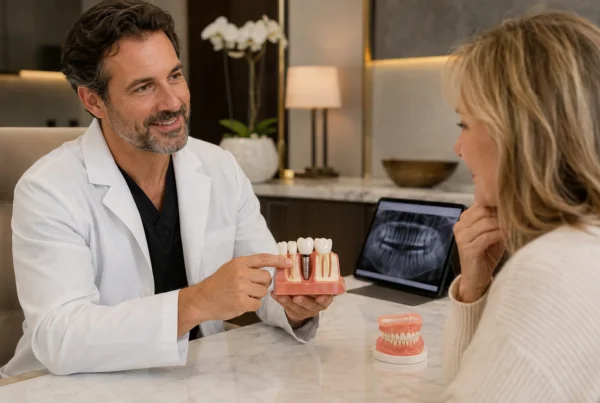



Dental implants and bridges both replace a missing tooth, in completely different ways. Dr. Joseph Goodman, DDS, DMD, has restored both for 27 years in Beverly Hills. He trained in Germany, practices in the United States, and has placed over 500 implants. An implant replaces the root itself. A bridge spans the gap by crowning the two healthy teeth beside it.
His implant work includes bone grafting and full-arch cases. You are being asked to make an expensive choice you cannot easily undo. Most comparison pages list pros and cons, then leave you to decide. This one commits. It tells you where each option wins, and when a bridge is the better call.
What is the difference between a dental implant and a bridge?
An implant replaces one tooth and touches nothing else. A traditional bridge involves three teeth to replace one. The two teeth beside the gap become reshaped anchors. An implant is a titanium post placed into your jawbone. A bridge is a single porcelain or zirconia unit cemented over those reshaped neighbors.
The post fuses to bone over several months. Dentists call this osseointegration. A crown attaches on top once it holds. Bridges come in several forms. A traditional bridge uses both adjacent teeth, a cantilever bridge uses one. A Maryland bridge bonds wings behind the front teeth instead. Read how a dental bridge works for the full sequence. Or review dental implants in Beverly Hills for the surgical route.
Which lasts longer, an implant or a bridge?
An implant post outlasts a bridge in most mouths. Published patient guidance puts average bridge lifespan at five to 15 years. A well-integrated implant post can serve for decades. The crown on top still wears and may need replacing. Results vary by patient.
Lifespan depends more on your habits than the hardware. Grinding, smoking, and gum disease shorten both restorations. A bridge fails most often when an anchor tooth decays under its crown. When an anchor fails, you lose the bridge and sometimes the tooth. No dentist can promise how long your own restoration will last.
Does a bridge damage the healthy teeth next to the gap?
Yes. A traditional bridge permanently changes two healthy teeth. Your dentist removes enamel from both so dental crowns can seat over them. Those teeth are filed down and the enamel does not grow back. From then on, two teeth carry the chewing load of three.
This matters most when the adjacent teeth are sound. Reducing perfect enamel to fix a different tooth is a real trade. The calculation changes when those teeth already carry large fillings or failing crowns. Then the bridge costs nothing you were not already spending.
What happens to the jawbone under a bridge?
The bone under the gap shrinks because nothing loads it. Tooth roots stimulate the jawbone every time you chew. Remove the root and the ridge resorbs, fastest in the first months after extraction. A bridge sits above the gum and never reaches bone. An implant replaces the root, so the bone keeps working.
The effect shows over years in the shape of the ridge. The gum line under a bridge often hollows. Food then traps under the false tooth, which is called a pontic. Bone loss at the extraction site also narrows your options. Implants need adequate bone height and width.

How much do implants and bridges cost in Beverly Hills?
Replacement cost is the wrong first question. What drives it is the better one. An implant is priced across three stages, covering surgery, the abutment, and the crown. A bridge is priced as one three-unit restoration. Preparatory work moves the total more than the restoration does.
The table below sets the two side by side. It covers everything except price. The differences are structural.
| What you are comparing | Dental implant | Dental bridge |
| Teeth involved | One | Three |
| Surgery required | Yes | No |
| Treatment time start to finish | About five months | Two to four weeks |
| Effect on neighboring teeth | None | Both filed down for crowns |
| Effect on jawbone | Preserves bone at the site | Bone under the gap shrinks |
| Expected lifespan | Decades for the post, results vary | Five to 15 years, results vary |
| Typical insurance treatment | Often excluded or capped | Often covered as standard |
| Best suited to | Healthy bone and neighbors | Compromised neighbors or a fast timeline |
Bone grafting, extractions, and sedation change an implant quote most. Ask any office for a written treatment plan with codes. Two practices quoting different figures are often quoting different work.
When is a bridge the better choice than an implant?
A bridge is the right answer more often than implant marketing suggests. Dr. Goodman recommends one when the mouth argues for it. The reasoning is clinical, not financial. These are the conditions where a bridge is the honest recommendation.
- Both adjacent teeth already need crowns or carry large failing fillings
- Low bone volume at the site and you decline a bone graft
- Uncontrolled diabetes, active smoking, or medication affecting bone healing
- Active gum disease or gum recession not yet stabilized
- You need a working tooth in weeks rather than months
- Medical history makes elective surgery an unwise risk
None of those conditions is about price. A bridge is faster and less invasive. Some mouths are better served by one. If an implant is unlikely to hold in your bone, hear it before you pay. Where neither option fits, dentures in Beverly Hills may be the more sensible route.
How do you decide between an implant and a bridge?
The decision comes from a scan, not a conversation. A 3D scan measures bone height and width in one appointment. Gum health, bite forces, and the adjacent teeth get recorded too. The average implant case here runs about five months to final restoration.
Every recommendation starts with measurement. Here is what gets recorded first. Your scan settles most of it.
- Bone height and width at the site, taken from a 3D scan
- Condition of the two teeth beside the gap
- Gum health and any active periodontal disease
- Medical history, current medications, and smoking
- How your bite loads that section
- Your timeline and willingness to wait through the healing time
You leave with a plan rather than a pitch. Dr. Goodman explains what each route costs you in time and tooth structure. Where the honest answer is a bridge, he says so. Where an implant is stronger for oral health long term, he says that instead.
Get a straight answer on which one fits your mouth
Dr. Joseph Goodman, DDS, DMD, has practiced restorative and cosmetic dentistry in Beverly Hills for 27 years. He trained in Germany and holds California dental license number 47521. He has placed over 500 implants, including full-arch cases. Patients travel to him from Bel Air, West Hollywood, and Westwood.
Bring your question to a complimentary consultation. You get a 3D scan and a clear read on your bone. You also get a direct recommendation on single tooth replacement. If a bridge serves you better, you will hear it in the chair. The goal is chewing on both sides again without thinking about it. Call (310) 860-9311 or book your consultation at topbeverlyhillsdentist.com.
Implant and bridge questions patients ask
Can you replace a bridge with an implant later?
Usually yes, though rarely as clean as starting with an implant. Your dentist sections and removes the bridge, then assesses the site. Bone under the pontic has often shrunk, so grafting is common before placement. The Cleveland Clinic overview of dental bridges confirms only a dentist can remove a fixed bridge. The two anchor teeth also stay reshaped, so they need crowns regardless. Outcomes vary by site.
How long does each treatment take from start to finish?
A bridge takes two to three visits across two to four weeks. An implant takes months, because bone must heal around the post first. The Mayo Clinic guide to dental implant surgery explains bone healing needs time. It can run over many months. Cases at this practice average around five months. Extraction healing or bone grafting extends it, and healing rates vary.
Can you get an implant if you have been missing the tooth for years?
Often yes, though preparatory treatment becomes more likely. Bone at an empty site narrows and loses height over time. The American Academy of Periodontology lists adequate jawbone as a candidacy requirement, alongside healthy gums. Where bone is thin, ridge modification or sinus augmentation can rebuild the site first. A single 3D scan settles the question. Results vary by patient.
Which is easier to clean, an implant or a bridge?
An implant. You brush and floss around it like a natural tooth. A bridge requires threading floss underneath the pontic every day. Trapped food is the most common complaint. The American Dental Association notes some patients choose implants to avoid removing sound tooth structure. Cleaning habits influence how long either restoration lasts.