

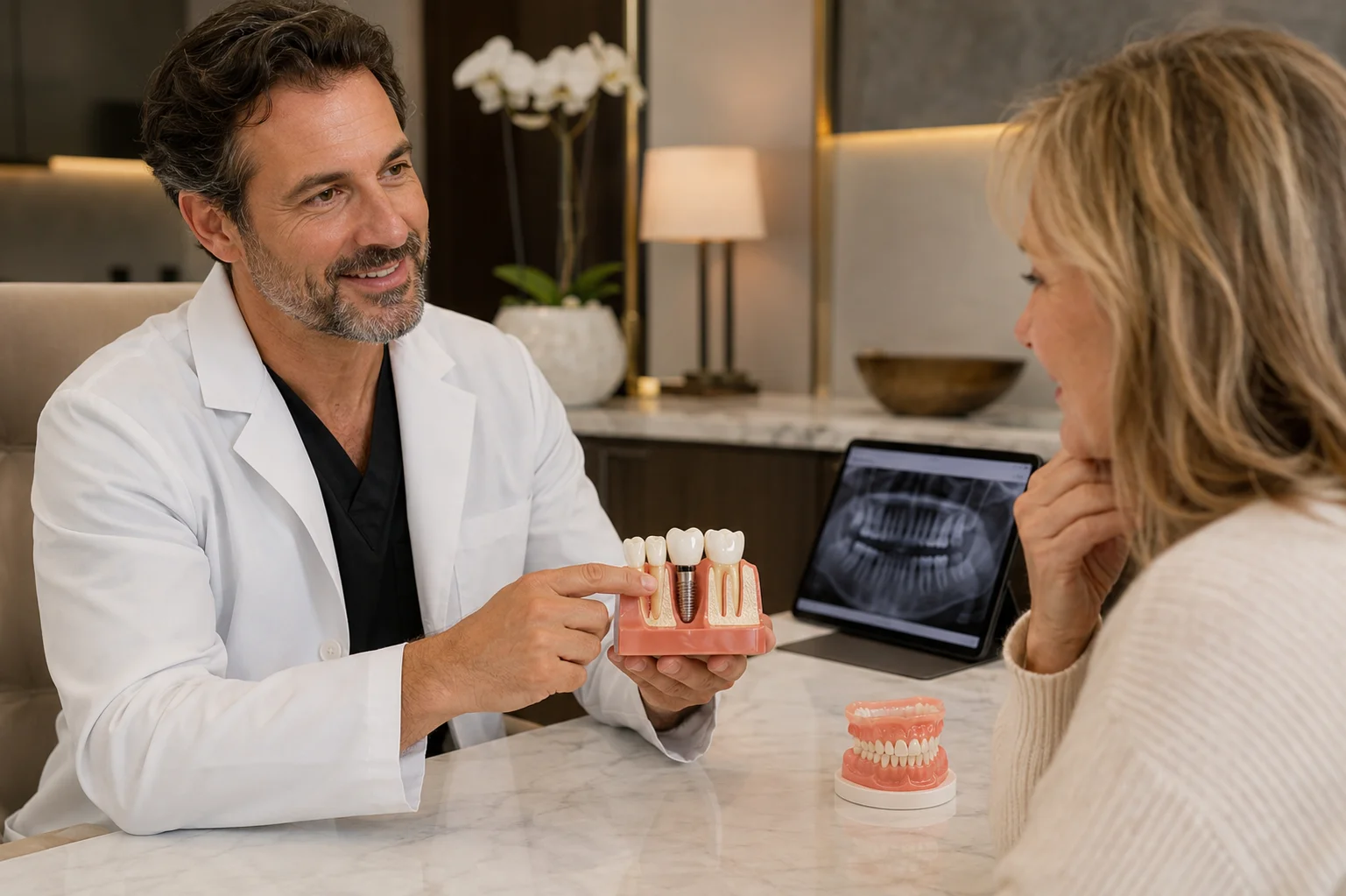

Dental implants and dentures both replace missing teeth. Which one fits comes down to the bone you have left in your jaw. Dr. Joseph Goodman, DDS, DMD, has placed more than 500 of them in Beverly Hills. He trained in Germany and the United States, and insurers call him in as an expert witness. Nearly everyone who sits down carries the same worry, which is walking out with obviously fake teeth.
Three things decide this. You need enough bone, enough healing time, and a settled view on removable teeth. Price is not on the list. Get the order wrong and plenty of people pay for the same problem twice. Years in a denture thin the ridge an implant needs later. The bone rules, the timelines, and the reasons a dentist says no are all knowable up front.
What Is the Real Difference Between Implants and Dentures?
An implant has three parts. A titanium post goes into the jawbone. An abutment screws into the post, and a crown finishes the tooth on top. A denture is a single piece resting on your gum. It never touches bone, and that one difference drives everything else. That is also why an implant feels like a tooth while a denture feels like an appliance.
Chewing power and daily upkeep both trace back to it. Dr. Goodman places the implants himself instead of handing the surgery to somebody else. That keeps the plan and the result in one pair of hands. His full step-by-step sequence lives on the dental implants page, and it is worth a read first.
What Happens to Your Jawbone With Each Option?
Once a tooth is out, the bone that held it starts shrinking. The loss moves fastest in the first six months. Most people never feel it happening, which is why the timing question sneaks up on them. Pooled human research puts horizontal bone loss at 29 to 63 percent in that window. Vertical loss runs 11 to 22 percent over the same stretch. Those numbers come from a 2012 systematic review of post-extraction changes in Clinical Oral Implants Research. That clock runs whether you decide or not.
An implant slows the shrinking. Chewing pressure travels down the post into the bone, so the bone keeps getting a reason to stay. A denture does the reverse. It presses on the gum while the ridge underneath quietly gives way. That is why dentures loosen and need relining. Bone response varies from person to person, so only a scan of your jaw shows where you sit.
Do You Have Enough Bone for a Dental Implant?
You need enough ridge height and width to hold the post clear of the sinus and the nerve. Sinus position, nerve position, and ridge width all get checked on the same scan. Roughly 80 percent of implant patients here need grafting or a membrane first. That runs well above average, and it reflects the kind of case that walks through this door.
- Ridge height and width clear of the sinus and the nerve
- Healthy gums, with any gum disease treated first
- Blood sugar under control
- No heavy smoking during the healing window
- A socket that has filled in after an extraction
Grafting is not a setback but planned work. It shows up on the scan long before it shows up on a bill. Bone gets measured, never guessed at. If your ridge cannot hold a post today, a 3D scan says so before any money moves.
Implants and Dentures, Side by Side
Here is the whole comparison in one place. Read it as a picture of where each option genuinely wins, rather than as a scorecard. Neither column is the right answer for everybody.
| Factor | Dental implants | Dentures |
| How they attach | Titanium posts fused into the jawbone | Rest on the gums, held by suction or adhesive |
| Effect on the jawbone | Chewing load helps hold ridge height | The ridge keeps resorbing underneath |
| Chewing force | Close to natural teeth | Reduced, and it varies with fit |
| Typical timeline | Roughly five months in this practice | A few weeks |
| Daily upkeep | Brushing, flossing, professional cleanings | Nightly removal, relines, remakes |
| Expected lifespan | Built to last for years, results vary | Relines and remakes along the way |
| Upfront cost | Higher, and grafting moves it further | Lower, with costs arriving later |
Most people assume dentures are what happens when you get older. The national numbers stopped supporting that. Complete tooth loss among adults 65 and over fell from 29.9 percent to 13.1 percent. That figure is age-adjusted and comes from NCHS Data Brief No. 368, published in June 2020. It covers 1999 through 2018, and far fewer people face that version of the decision now.

How Long Does Each Option Take From Start to Finish?
An implant case here averages about five months, consultation to final restoration. That figure covers healing rather than chair time, and most of it is waiting. A conventional denture is done in weeks. Around 40 percent of people who come in for an implant consultation are not candidates yet. Most of them need healing, grafting, or an extraction first. Better to hear that on day one.
Timelines stretch for two boring reasons, which are how a body heals and how a calendar fills. Patients from Century City or Westwood stack their visits. Wilshire Boulevard traffic makes that worth planning. Results vary from person to person, and no quoted timeline is a promise.
What Makes Implants Cost More Than Dentures?
Three line items open the gap: the surgery, the components, and the healing time between them. A denture carries none of the three. It is a lab-made appliance with no surgical phase at all. The gap does narrow over a longer horizon, since dentures need relines and eventual remakes.
Grafting is the biggest swing factor on any implant quote. A single-tooth case sits nowhere near a full-arch rebuild on thin bone. Two people can hear very different numbers for what sounds like the same problem. Quoting either one from a web page is guesswork, which is why the scan comes before the number. Coverage is its own puzzle, and plans differ widely. There is a fuller breakdown in the article on whether insurance covers dental implants.
Can You Start With Dentures and Move to Implants Later?
Yes, and 75 full-arch cases here were built that way. Some used All-on-X, others an implant-supported denture. Plenty of patients take that route and finish with a fixed arch a year or two later. Starting with a conventional denture is a legitimate first move when the bone needs healing. It also works when the budget needs staging.
- A conventional denture while the extraction sites heal
- Grafting to rebuild the thinned ridge
- Two to six implants to carry the arch
- A fixed bridge or a snap-in overdenture on top
- A cleaning schedule that protects the tissue
The catch is that the ridge keeps shrinking while you wait, so the graft later is bigger. Dr. Goodman will tell you when the conservative route is right, even where the bigger case pays better. If you want the removable option done properly, start on the dentures page.
Find Out Which One Your Jaw Can Support
Dr. Joseph Goodman, DDS, DMD, has spent 27 years rebuilding bites in Beverly Hills. He trained in both Germany and the United States. Patients come to him from Century City, Holmby Hills, and the Cedars-Sinai Medical Center corridor. More than 500 implants and 75 full-arch cases sit behind the work. Three generations of families have come through the practice, which says more than any credential list.
What people describe afterward is refreshingly ordinary. They eat what they want and stop thinking about their teeth. A consultation gets you a 3D scan and a straight read on your own bone. Both options come priced against your mouth rather than an average. Call (310) 860-9311 or visit Dr. Goodman’s Beverly Hills practice to book a time.
Questions Patients Ask About Implants and Dentures
What is the downside of having dental implants?
The downsides are surgical. You are agreeing to surgery with a healing period. Nerve or sinus involvement is rare, and a post occasionally fails to fuse. Mayo Clinic notes in its overview of dental implant surgery that these risks are small and usually minor. The bigger downside is patience. Bone healing sets the pace and nothing hurries it. Anyone promising a finished implant in two weeks is selling something.
Why would a dentist not recommend an implant?
Sometimes the honest answer is that your own tooth is worth keeping, and a crown beats pulling it. Some conditions rule it out until they are handled. Cleveland Clinic’s guidance on dental implants lists untreated gum disease, unmanaged diabetes, and severe jawbone loss. It also notes that smoking disrupts healing. A dentist who says no is doing the job properly, and a second opinion costs you nothing.
Is it worth getting dental implants at 70 years old?
Age on its own rules nothing out. A 2025 systematic review covering 3,892 implants found five-year survival of 96.8 percent past age 75. The comparable figure for the 65 to 75 group was 92.1 percent. The authors of that analysis of implant survival in older adults concluded implants stay reliable well past 75. General health and bone quality matter far more than a birthday, and results vary.
Will Medicare pay for dentures or implants?
In most cases, no. Medicare states on its page covering dental services that dentures and implants are generally not covered. Narrow exceptions exist, tied to a covered medical treatment. Some Medicare Advantage plans add dental benefits, though terms vary by plan and by year. Check the annual maximum before you assume a plan covers a full arch. This practice does not participate in Medicare, though it does accept PPO plans.