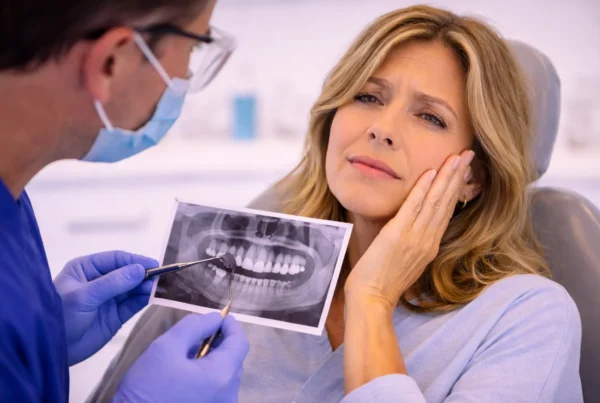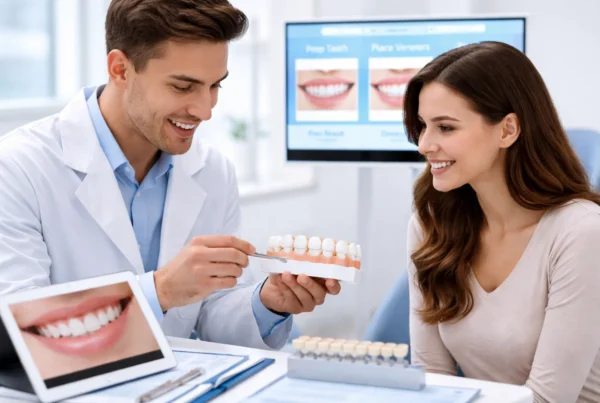

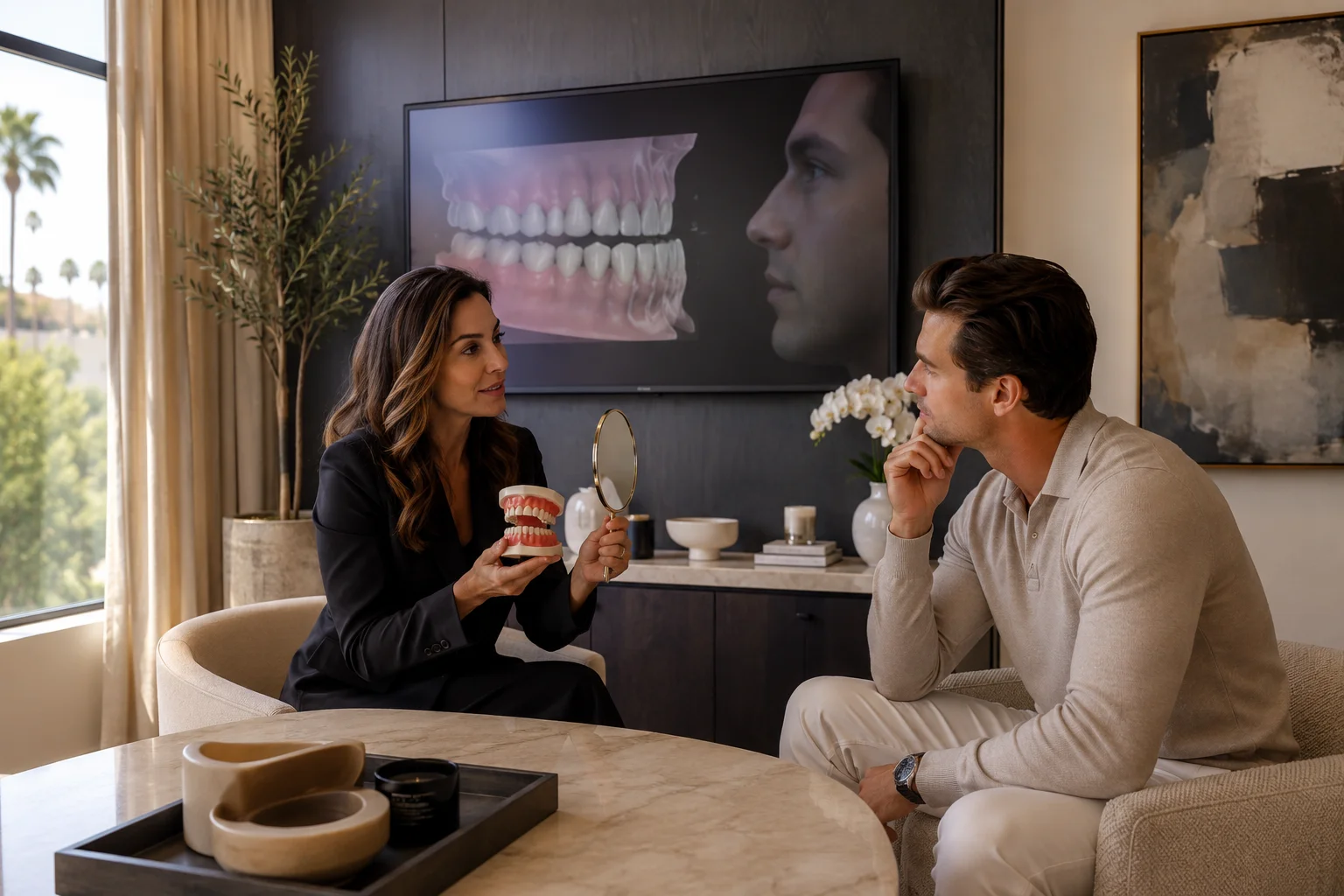

Crossbite correction in Beverly Hills rarely needs jaw surgery, and that holds for adults who were told otherwise. Dr. Joseph Goodman, DDS, DMD, has corrected bites in this city for 27 years now. He holds California license 47521 and trained in both Germany and the United States. Crossbites sit among the more straightforward cases he treats. He handles them in-house rather than sending you to a surgeon.
Most people arrive worried about two things. One is being sent for jaw surgery they cannot face, and cannot take the time off for. The other is two years in appliances on a plan that never held. A crossbite left alone keeps wearing your teeth unevenly and pulling the jaw off-center over time. Waiting has its own cost. Below is how the non-surgical route works and which tools apply to which type. You will also see what tells you where your own case falls.
Can a Crossbite Be Corrected Without Surgery?
Yes. One study compared 43 adults who had surgically assisted palatal expansion against a second group. Those 38 received customized lingual appliances and no surgery at all. Measured at the canines, second premolars, and both sets of molars, neither group came out ahead of the other. The difference in total correction was not statistically significant.
That matters. Surgery gets presented as the serious option, and everything else as a compromise. Careful tooth movement across both arches reached the same place as the operation did. Dr. Goodman’s approach to bite correction starts there. It moves toward surgery only where the skeleton genuinely demands it, and that is a small group.
Which Type of Crossbite Do You Have?
Type decides tool, so an exam settles this before anything else. A crossbite means upper teeth close inside the lower ones instead of outside them. It can sit at the front, at the back, or on one side.
- Anterior crossbite, where upper front teeth sit behind the lower ones
- Posterior crossbite, where back teeth on one or both sides close inside the lower arch
- Unilateral crossbite, affecting a single side and often shifting the jaw when you close
- Dental crossbite, where the jaws line up and the teeth are tipped
- Skeletal crossbite, where the upper jaw itself is too narrow for the lower
When every upper front tooth sits behind the lower ones, that is a different diagnosis entirely. Non-surgical underbite correction covers that one instead, and it is a genuinely different plan. Getting the label right is not academic. A dental crossbite and a skeletal one need different appliances, different timelines, and different conversations about cost.
How Does a Dentist Fix a Crossbite?
Treatment widens the upper arch, moves the teeth, or does both together. Which of those you need follows directly from the type your exam identified. The table below sets the four routes side by side so you can see where yours is likely to land.
| Expander | Clear aligners | Braces | Jaw surgery | |
| Best for | Narrow upper jaw | Dental crossbite, mild to moderate | Larger tooth movements | Severe skeletal cases |
| Removable | No | Yes | No | Not applicable |
| Adult use | Often combined with other tools | Common | Common | Reserved for severe cases |
| Typical timeline | Months, then finishing | 12 to 24 months | 12 to 24 months | Two to three years total |
Gum disease and decay get treated first. Teeth travel safely only through healthy bone, with healthy tissue holding everything around it. He also treats the bite and the face together rather than one tooth at a time. That thinking sits behind his FACE Dentistry work. Where the jaw joints are already sore, a TMJ and TMD assessment runs alongside the correction plan.
How Long Does Crossbite Correction Take and What Does It Cost?
Non-surgical crossbite correction usually runs 12 to 24 months. How far the teeth have to move is what sets your own number inside that range. Treatment often falls somewhere between 3,000 and 8,000 dollars. An expander adds to that figure when a narrow upper jaw has to be widened first. Beverly Hills pricing sits somewhat above the national average, as it does across most of this market.
A simple aligner case lands at the lower end. Cases that need both an expander and braces land nearer the top of that range. Dr. Goodman quotes after the exam, never before, because a number given without imaging is a guess. Patients from West Hollywood and Brentwood always ask which end they land on. The exam decides, in one visit.
Is It Too Late to Fix a Crossbite as an Adult?
No. The tools change once jaw growth finishes, and that is the whole difference. In children the palate is still two halves, and those halves can be widened apart. Early expansion works well for that reason. In adults the suture has fused, so the route changes. Correction then comes from moving teeth within the bone rather than splitting it apart.
That distinction is what makes adult treatment sound harder than it turns out to be. Expansion and compression across both arches reaches the same bite, as the comparison research shows. Dr. Goodman does not do unnecessary work. He tells you before you spend a dollar if a case genuinely needs surgery.
Get a Straight Answer About Your Bite
An exam settles what a photograph and an afternoon of searching cannot. Dr. Joseph Goodman, DDS, DMD, has spent 27 years correcting bites at his Beverly Hills practice. It sits off Santa Monica Boulevard, minutes from Beverly Hills City Hall. His training in Germany and the United States built a practice that treats bite and face as one system. Patients want a jaw that closes evenly and teeth that stop wearing down.
Bring any imaging you have, plus whatever you were told elsewhere. You will leave knowing whether your crossbite is a dental problem or a skeletal one. That answer sets everything else. Call (310) 860-9311, or read what patients say about the experience. Results vary by case. You will get a straight answer either way.
Questions Patients Ask About Crossbites
Can you fix a crossbite naturally?
No, a crossbite does not correct itself, and no exercise or stretch will ever move it. Nor will any appliance you buy online without an exam. Malocclusion is largely hereditary. Cleveland Clinic notes that providers treat it with orthodontics, or surgery in severe cases. Tooth position changes only under sustained, directed force from an appliance fitted to your mouth. At home you can only protect the teeth already under strain. Keep the gums healthy, and report new soreness early. Everything past that needs a clinician, imaging, and a real treatment plan.
What is the best age to correct a crossbite?
Around age seven is the simplest window, because the jaws are still growing then. The American Association of Orthodontists recommends a first check no later than that. It names anterior crossbite as a case that benefits from early interceptive treatment. Catching it then can mean one brief phase of appliance work instead of a long one later. Adults remain entirely treatable, and the tools available differ rather than disappear. Age changes the route, not the destination.
Are palate expanders worth it for adults?
For the right case they are, and the measured results run better than most patients expect. A study of 64 patients used customized expansion and compression archwires in both arches. Every posterior crossbite in that group was corrected. The mean total correction reached 6.9 millimeters, with a maximum of 12.8. That came from widening the upper arch while narrowing the lower one. Adult expansion works differently, since the palatal suture has fused. Your exam and imaging decide whether your own case fits that approach.
What happens if a crossbite is left untreated?
The bite keeps compensating, and that compensation is what does the damage over years. Untreated malocclusion is associated with tooth wear, decay, and gum disease. It affects how you chew and speak, as MedlinePlus describes. A unilateral crossbite also shifts the jaw sideways on closing, loading one joint harder than the other. None of it arrives suddenly, so people live with it for decades. The cost of waiting shows up as worn teeth and a sore joint, not as pain today.